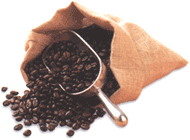
Coffee Making
The coffee tasting process is a delicate one, involving several
key factors to assess and discern coffee qualities. The
experienced coffee taster usually starts assessing the color and
appearance of a cup of coffee, followed by the appreciation of
aroma, flavor, bitterness and texture:
Coffee Beans: Different types of coffee beans provide for different
aromas and flavors. Arabica (Coffea Arabica) and Robusta (Coffea
canephora) make up for about 90% of the coffee beans sold
worldwide.
Coffee Aroma: Generated during the roasting of the beans, the aroma is
a mix of over 800 aromatic compounds that make up for the subtle
balance between fruity, nutty, roasty and more caramel-like
aroma notes.
Bitterness: An integral part of the coffee tasting experience,
bitterness provides that sharp, vibrant quality, without which
the beverage would taste flat.
Coffee Texture: By accessing texture, a trained coffee taster can
assess attributes like the body (weight and richness),
smoothness and aftertaste of a coffee. Texture attributes are
key when selecting a type of coffee over another.
Coffee Flavor: Strong linked to aroma, the flavor depends very much on
the coffee species. Experts consider Arabica to be richer and
more aromatic, and Robusta to be more robust and stronger. The
beans' origins and the coffeemakers' expertise do the rest for
the flavor experience.
Brewed or Instant Coffee?: There are many ways to enjoy coffee. Some
people percolate their coffee; others use French presses or
coffee plunger. Then there are also espressos, concentrated
coffee beverages brewed by forcing hot water under pressure
through ground coffee. However, all these take more time to
prepare, compared with the convenience of instant (soluble)
coffee. Just add hot water to coffee powder or granules and
you'll be savoring the perks and pleasures you'd expect from a
great cup of coffee!
 About
Espresso
About
Espresso
Espresso is actually a strong, dark-roasted type of coffee which
is brewed by using a distinctive steam-extraction method.
Espresso started in Italy, however it's currently well-known
worldwide. You will find many coffee recipes in this coffee
making website that make use of espresso as the actual primary
ingredients. Previously, many people linked the word espresso
with a strong and bitter coffee. Nevertheless, we have seen a
fresh understanding of espresso and top quality coffees
generally established during the last several years as a result
of articles in publications, newsprint and campaigns from the
coffee industry. Therefore, the consumer is becoming far more
complex and critical in their taste, and the past reputation
regarding espresso continues to be replaced by the passion for
espresso-based beverages as shown from the long queues at the
espresso stands.
The word espresso is actually Italian pertaining to fast and
mainly details the process of preparation. The espresso brewing
technique utilizes pressure as opposed to the law of gravity to
swiftly acquire the essence from the coffee within a
concentrated form. Espresso can also be used to explain the
blend of coffee beans and also the extent of roast for the
coffee beans used to make espresso. Espresso roast is amongst
the darkest roasts and is also indicated by a rather burnt
flavor.
Just about all coffee specialty stores will have industrial
espresso equipment and serve both espresso as well as espresso
beverages to a increasing number of coffee lovers. Besides the
specialty stores, curbside espresso carts and drive-through
espresso outlets have popped up throughout the larger
metropolitan location. Today, it appears that each and every
shopping center and superstore features its own espresso
station.
From the coffee orchard to your cup
-
Harvest the coffee beans:
The coffee 'cherries' change from green to deep red or yellow as
they ripen over 9 months, then they are harvested by hand. The
cherries are then either sun-dried or soaked in water to
separate the coffee beans from the skin, pulp and parchment.
-
Roasting coffee beans:
This is when the sugars, fats and starches within the beans are
emulsified, caramelized and released, creating the delicate
coffee oil which provides for the aroma. The temperature and
roasting time affect the color, which in turn determines the
strength of the brew.
-
Grinding the coffee beans:
The beans are then ground into the desired size; course, medium,
fine or very fine.
-
Making instant coffee:
The ground coffee is put into an industrial percolator
containing pressurized hot water to brew highly concentrated
liquid coffee. The coffee liquor, as it is called, can then be
either spray dried or snap frozen then ground again into fine particles.
How about a decaff?
For those of you who prefer to enjoy the full flavor of coffee
without its stimulating effects, there is decaffeinated coffee,
which contains less than 0.3% of caffeine. But how is it made?
Most decaffeination methods consist of soaking the beans in
water to dissolve the caffeine, extracting the caffeine with a
solvent, and then re-soaking the beans in the water to reabsorb
the flavor, creating that some flavorful beverage.
Essence of Coffee
Coffee, the beverage we all relish, has touched our hearts in so
many ways with its rich aroma and irresistible flavor, But those
aren't the only great things about coffee; its benefits on the
mind and body are key in how coffee has found an intimate spot
in your lives.
Coffee and your Mind
Just one cup can result in contentedness, lower anxiety, more
self-confidence and higher motivation! In the morning, it gives
us exactly what we need to tackle the tasks ahead to make it a
great day. At work, coffee enhances cognitive performance,
allowing us to better process information from the world around
us. If you're on the road and fatigue creeps up, get a coffee
and take quick nap to restore alertness. Times with friends and
family are special. Drinking coffee uplifts our mood and lets us
enjoy those special times with our loved ones. Working night
shifts? Drinking coffee can help us maintain day-time alertness
levels at night.
Coffee and your Body
It has been shown that coffee can enhance muscle contraction,
improve neuromuscular transmission and increase peak force
generation. That means you get to exercise at a more intense
pace, for a longer period and gain more from your workouts!
Not only that, in some studies, coffee demonstrated an increase
in metabolism after consumption. The higher you fat metabolic
rate, the faster your body breaks down fat and the better you
look and feel.
There are misconceptions that drinking coffee promotes diseases.
However, the years of research until today have not uncovered
any sound evidence to support them. Conversely, studies are
increasingly pointing towards coffee's possible preventive
effects on certain diseases!
Coffee Myths and Mysteries
So great was the mystique ascribed to coffee, that conjecture
over the who, how and when of the invention of the beverage and
the discovery of its properties was intense. Doctors, lawyers,
poets and philosophers all had their pet theories and great
kudos was linked to association with the so-called "discovery".
As a result, in medieval Arabia and later in the 17th century
Europe, stories and legends were rife.